
If you ask ten Nigerians in crypto what they are holding right now, at least seven of them will say USDT. It is the default. It is the stablecoin people run to when the market gets shaky, it is also the one freelancers ask clients to pay in, the one traders park their profits in between positions.
But a lot of people who hold USDT cannot fully explain what it is or how it works. This guide explains what USDT is, and also how to actually use USDT in Nigeria.
In this Guide
What Is USDT?
USDT stands for US Dollar Tether. It is a stablecoin, which means it is a cryptocurrency designed to hold a fixed value rather than fluctuate with the market. One USDT is always worth approximately one US dollar.
It was created by a company called Tether Limited and launched in 2014. The idea was to give people the speed and accessibility of crypto without the price volatility that makes Bitcoin and other crypto assets unreliable for everyday use.
USDT does not have its own blockchain. It runs on top of existing networks like Ethereum, Binance Smart Chain, Solana, and Base, which means it can be sent across the same infrastructure that other cryptocurrencies use.
By market capitalization, USDT is consistently one of the three largest cryptocurrencies in the world. Most of the trading volume on major exchanges runs through it.
How Does the USDT Dollar Peg Work?
The reason USDT stays at one dollar is that Tether Limited maintains reserves meant to back every token in circulation. The idea is that for every USDT that exists, there is a corresponding dollar (or dollar-equivalent asset) held in reserve.
In practice, those reserves include cash, US Treasury bills, and other short-term financial instruments. Tether publishes quarterly attestation reports showing what is held, though it has faced ongoing scrutiny over whether those reports represent a full audit.
The peg has held remarkably well over the years. USDT has briefly dipped below a dollar during periods of market stress but has consistently returned to its target price. For most users, day-to-day stability is what is important, and on that front USDT has a strong track record.
P.S: Tether Limited is a private company, not a government institution, so USDT is only as stable as the company behind it. The reserves are not government-insured. In the event of a serious systemic failure at Tether, the peg could break. For everyday use and short-to-medium term holding, the risk is considered low. For long-term storage of large amounts, it is worth understanding the distinction between USDT and actual dollars.
How Nigerians Actually Use USDT
USDT fills a specific gap in the Nigerian financial landscape. The naira has faced significant devaluation over the years, and dollar-denominated savings in a traditional bank account are not straightforward to access. USDT offers dollar stability through a crypto wallet, which anyone with a smartphone can hold.
The most common use cases are listed below:
| Use case | What it looks like |
| Dollar savings | Converting a portion of naira income into USDT monthly to protect against Naira devaluation. More accessible than a domiciliary account. |
| Freelance payments | International clients pay in USDT. The freelancer holds it or converts to Naira as needed, without going through a bank wire. |
| Crypto trading | Traders park profits in USDT between positions to avoid exposure to market volatility while staying liquid. |
| Sending money | USDT can be sent across borders in seconds for a fraction of what remittance platforms charge. |
| Everyday payments | Using USDT to pay vendors, settle bills, or send money to family in Naira, directly through platforms like Resolva. |
USDT Networks: The Significance of the Network You Send from
USDT exists on multiple blockchains simultaneously. The token is the same and the value is the same, but the network it travels on is different. This creates one rule that anyone sending USDT must understand. The network on the sending end must match the network on the receiving end.
Sending USDT on BSC to a wallet address that is set up for ERC20 will result in the funds not arriving. The addresses look similar enough to cause confusion, but they operate on different infrastructure.
Resolva supports four USDT networks:
| Network | Also called | Speed | Best for |
| BSC | BEP20 | Fast | Most wallets in Nigeria. Popular on Binance, Bybit and Trust Wallet. |
| ERC20 | Ethereum | Slower, higher fees | Widely supported but costs more to send. |
| Base | Base Network | Fast, low fees | Growing option, common on Coinbase. |
| Solana | SOL Network | Very fast, very cheap | Phantom, OKX, active crypto users. |
Always confirm the network on both ends before sending. The coin and the network must match.
How to Spend or Convert USDT to Naira in Nigeria
Most apps that claim to help Nigerians use USDT are really just helping them convert it. The USDT becomes Naira in a personal bank account, and then a separate transfer is made to whoever actually needed the money. That is two transactions where one should have been enough.
While many apps like Breet, Crane, and Koyn help Nigerians convert USDT to Naira, Resolva is the only app that actually lets people spend it directly. ‘Send’ on Resolva takes USDT and delivers Naira directly to any Nigerian bank account in one flow. A landlord, a vendor, a family member. They receive a standard bank transfer. The crypto part is invisible to them.
For anyone who wants the Naira in their own account instead, Receive on Resolva handles the conversion and settlement directly.
The full step-by-step guide for both features is covered in How to Spend or Convert USDT to Naira in Nigeria in 2026. Setting up a Resolva Individual account is the starting point for either.
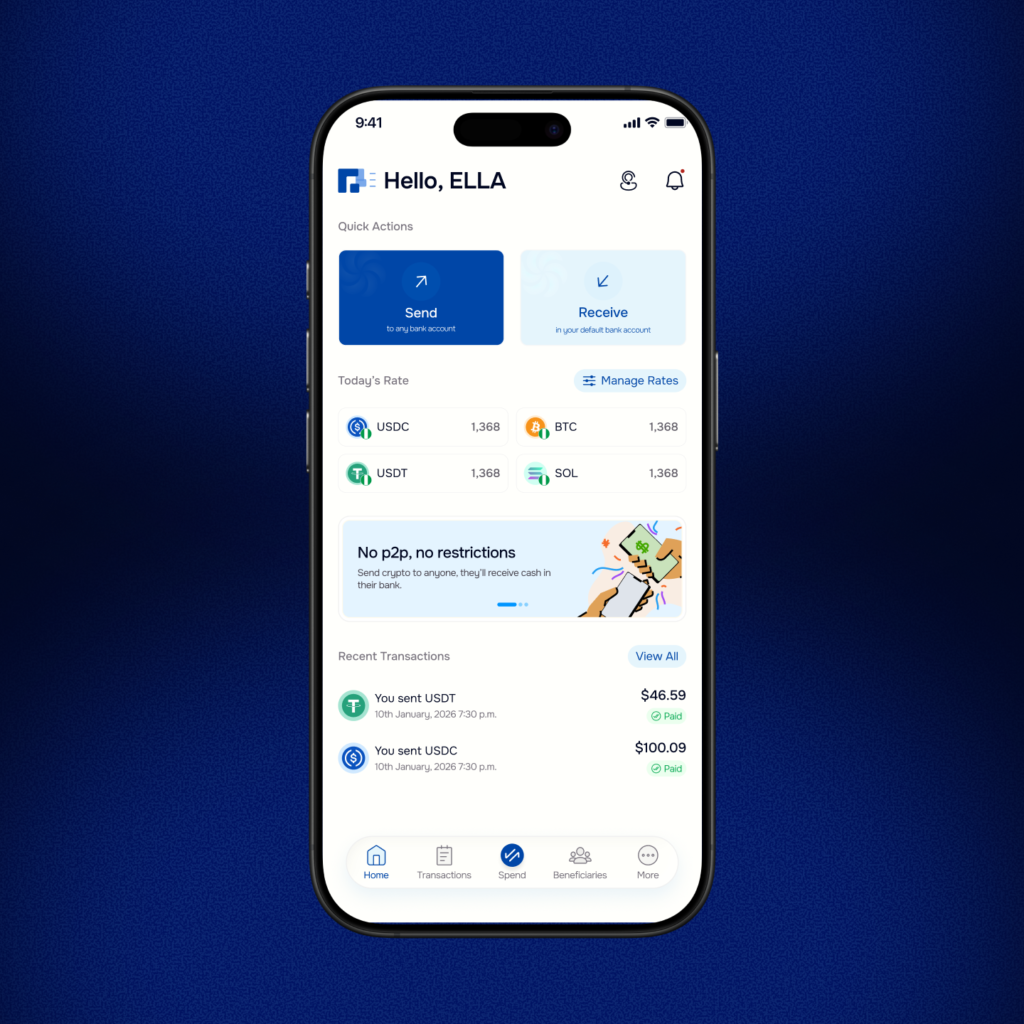
Spend your USDT like Naira.
Download Resolva and set up an Individual account to get started.
FAQs
Is USDT the same as a US dollar?
Not exactly. One USDT is worth approximately one US dollar, but USDT is a cryptocurrency token issued by a private company, not a government-backed currency. It cannot be used everywhere dollars are accepted and does not carry the same legal protections. For practical purposes in Nigeria, most people treat them as equivalent in value.
Which USDT network is best for sending in Nigeria?
BSC (BEP20) is the most widely used in Nigeria because it is fast and inexpensive, and most Nigerian crypto users are already set up on wallets that support it like Binance and Trust Wallet. Solana is also a strong option for speed and low fees.
Can USDT lose its value?
The peg has held well since 2014, but USDT is not risk-free. It is backed by Tether Limited’s reserves, not by a government. During extreme market stress, the peg has briefly dipped. For everyday use it is reliable, but it is worth understanding it is not the same as holding actual dollars.
How do I convert USDT to Naira in Nigeria?
The quickest way is through Resolva. Send USDT to a Resolva wallet address and the Naira equivalent lands in a connected Nigerian bank account almost instantly. The full guide is here: How to Spend or Convert USDT to Naira in Nigeria.
Can I pay someone directly in Naira using USDT?
Yes, with Resolva’s Send feature. The recipient gets a standard Naira bank transfer. They do not need a crypto wallet, a Resolva account, or any knowledge of how it works.
What is the difference between USDT and USDC?
Both are stablecoins pegged to the US dollar. USDC is issued by Circle and is generally considered more transparent in its reserve reporting. USDT is more widely used globally and has greater liquidity on most exchanges. Both are supported on Resolva.